DDR Architecture Design: 01. DDR5 Channel and Sub-channel Structure
The "sub-channel" architecture in DDR5 was introduced to address a challenge that arises as data rates increase: how to maintain high memory bandwidth without making the access granularity excessively coarse.01. What is a Channel?
A channel is a data path between a memory controller and a set of DRAM chips. It comprises a complete suite of signals, including data lines (DQ), data strobes (DQS), command/address (CA) lines, clock signals, control signals, power, and reference signals.In traditional DDR, a single memory channel has a data width of 64 bits. This 64-bit figure represents the number of data bits transmitted in parallel across the data bus during a single transfer. For instance, when a desktop platform is described as having "dual-channel" memory, it means the CPU's memory controller possesses two independent 64-bit data channels, effectively doubling the theoretical bandwidth.
In essence, a channel is a comprehensive set of communication resources between the controller and the DRAM—it is far more than just a few DQ lines.
02. The 64-bit Channel in DDR4
A DDR4 DIMM data channel is 64 bits wide. On a non-ECC UDIMM, this channel consists of 64 data lines; for server modules equipped with ECC, additional bits are included for error correction. When the controller initiates an access to this 64-bit channel, data is transmitted continuously in a "burst" format.DDR4 typically uses a Burst Length (BL) of 8 (BL8). In a single burst, each DQ line transmits 8 consecutive data units. Consequently, a single BL8 transfer across a 64-bit DDR4 channel yields:
64 bits × BL8 = 512 bits = 64 bytes.
Since 64 bytes matches the size of a standard CPU cache line, the combination of a 64-bit channel and BL8 in DDR4 is naturally well-suited for transferring a single 64-byte cache line in one operation.
However, as we move to DDR5, data rates continue to climb. If the same design philosophy were applied—maintaining a 64-bit channel while scaling up to, say, a Burst Length of 16 (BL16)—a problem arises: a single transfer would suddenly balloon to 128 bytes. For many types of memory access, this granularity is simply too coarse—much like trying to buy a single bottle of water, only for the shopkeeper to say, "Sorry, we only sell by the case." It’s not necessarily that you can’t afford it; it’s just that the whole situation feels a bit off.
03. DDR5 2×32-bit Sub-channels
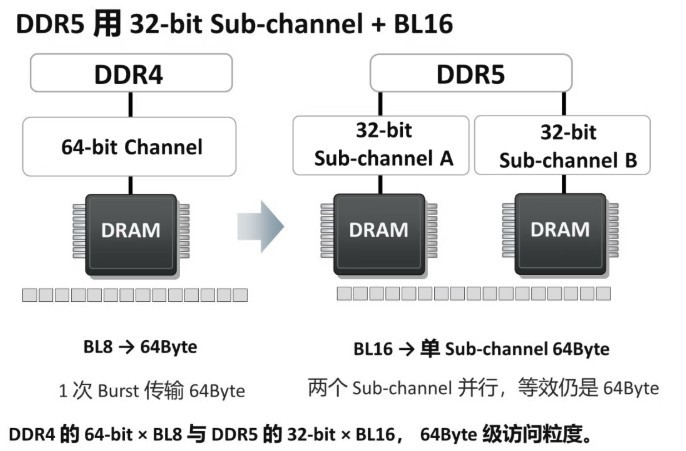
DDR5 employs two independent 32-bit sub-channels. A core motivation for this design is to maintain a reasonable data access granularity even when using a Burst Length (BL) of 16 (BL16).In DDR5, the Burst Length has been increased to BL16. If the data path were a single, unified 64-bit channel, a single transfer would amount to:
64 bits × BL16 = 1024 bits = 128 bytes
For certain scenarios, this is too large. It results in overly coarse access granularity, which can lead to wasted bandwidth and reduced flexibility in controller scheduling. DDR5 addresses this by taking a different approach: logically splitting the 64-bit channel into two 32-bit sub-channels. Consequently, the data volume for a single sub-channel with BL16 becomes:
32 bits × BL16 = 512 bits = 64 bytes
By extending the burst length while simultaneously subdividing the channel, DDR5 ensures that each access—via a single sub-channel—maintains a data granularity of 64 bytes.
This balances high data rates with efficient access; otherwise, the gains from higher speeds would be undermined by the inefficiencies of an excessively coarse burst granularity.
04. Sub-channels, BL16, and Prefetch
To understand DDR5 sub-channels, one must consider them in the context of BL16 and prefetch mechanisms. The changes in DDR5 represent a cohesive set of adjustments rather than an isolated modification.DDR4 typically utilizes an 8n prefetch, a Burst Length of 8 (BL8), and a 64-bit channel. In contrast, DDR5 employs a 16n prefetch, a Burst Length of 16 (BL16), and two 32-bit sub-channels. On the surface, it may appear that various parameters are simply being "doubled" or "halved," but the underlying logic is to maintain a balance between access granularity and bandwidth efficiency.
Therefore, one should not interpret a "sub-channel" as DDR5 "cutting the number of data lines in half." A more accurate perspective is that DDR5 employs a more granular channel organization—combined with longer bursts and higher data rates—to enhance overall efficiency.
05. Sub-channel Scheduling for the Controller
The two sub-channels in DDR5 offer the controller the advantage of finer-grained scheduling. Previously, a single 64-bit channel functioned like a single large service window, where all requests had to queue up; with DDR5, the two 32-bit sub-channels act like two separate windows, allowing the controller to issue requests with greater flexibility.In real-world systems, memory access patterns are rarely neat, continuous sequences of addresses. Instead, they consist of a complex mix of requests from various sources, with differing sizes and priority levels. Sub-channels help reduce certain access conflicts, thereby improving the utilization of effective bandwidth.
It is important to distinguish "effective bandwidth" here. While "theoretical" (or "on-paper") bandwidth—calculated based on data rate and bit width—may look impressive, "effective bandwidth" represents the actual throughput a workload can achieve. The value of sub-channels lies not in conjuring up additional peak bandwidth, but in making the existing bandwidth more accessible and easier to utilize.
06. How do Channels, Ranks, Byte Lanes, and DRAM Device Bit Widths Relate?
Channel: A communication path between the controller and the memory.Sub-channel: A finer-grained unit for data access.
Rank: A collection of DRAM devices that respond simultaneously.
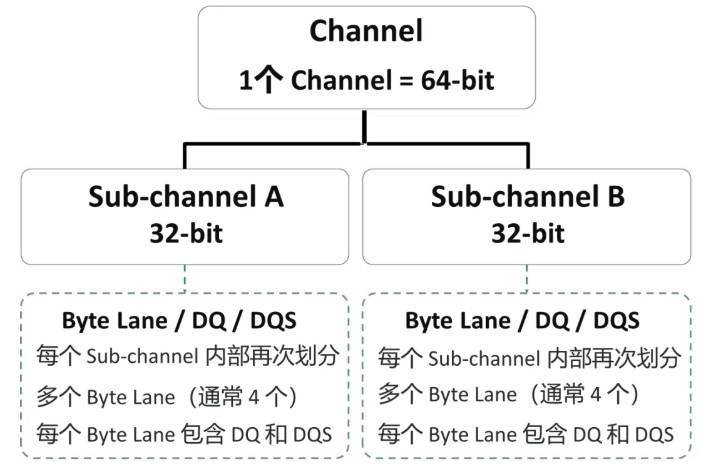
Byte Lane: An 8-bit data group, typically associated with a DQS (Data Strobe) signal.
x4/x8/x16: The DQ (data) bit width of an individual DRAM device.
For example, if x8 DDR5 devices are used, a 32-bit sub-channel can be formed by combining the data widths of four x8 devices. Two such sub-channels together utilize eight x8 devices to create a 64-bit data path.
In summary: Sub-channels define the granularity of controller access and data organization; Ranks define how DRAM devices are organized for simultaneous response; Byte Lanes serve as key local units for data sampling; and x4/x8/x16 denote the data width provided by an individual DRAM device.
07. Sub-channel Design and Evolution 1. Do not view the system solely in terms of the "full 64-bit channel."
1. Do not view the system solely in terms of the "full 64-bit channel."
In DDR5, the two sub-channels operate more independently; they must be examined separately during debugging. Certain margin issues may manifest only in sub-channel A, while others might appear exclusively in sub-channel B. Relying on the averaged results of the entire channel can easily mask localized problems.2. The "byte lane" is the fundamental unit for debugging.
While the architecture is organized into sub-channels, signal integrity debugging must ultimately focus on byte lanes, DQ, DQS, Vref, ODT, and drive strength. A single sub-channel contains multiple byte lanes, and the DQ-DQS relationship can vary for each one. Often, the stability of read/write operations is dictated by the weakest byte lane.3. Do not overlook CA, CK, and control signals.
Many focus exclusively on DQ signals because they exhibit the most activity. However, sub-channel scheduling, commands, addressing, and clock synchronization are equally critical. Given the higher data rates and more complex architecture of DDR5, factors such as CA fly-by topology, command timing, ODT configuration, and training sequences all significantly impact system stability.4. Pattern and SSO analysis require greater precision.
DDR is a parallel bus; simultaneous switching of multiple DQ lines can induce SSN (simultaneous switching noise), ground bounce, and VDDQ noise. While sub-channels allow for finer-grained access, power supply noise remains a factor. Testing should evaluate margins across different sub-channels, byte lanes, and data patterns.5. Margin reports should be broken down by sub-channel.
Debugging is significantly more efficient when training logs, eye diagrams, Vref sweeps, BER (bit error rate) data, or stress test results are segmented by sub-channel, byte lane, or rank. Simply stating that a DDR5 interface "passes" is unhelpful—it is as vague as saying "it seems fine." From an engineering perspective, the focus must always be on the worst-case performance point.
08. How should we understand DDR5 channels and sub-channels?
What exactly is the channel and sub-channel architecture of DDR5?DDR5 organizes the traditional 64-bit data channel into two 32-bit sub-channels. This allows memory access to maintain an appropriate granularity even at higher data rates, while also increasing the scheduling flexibility of the memory controller.
In the DDR4 standard, a 64-bit channel is paired with a burst length of 8 (BL8), resulting in 64 bytes per access. Because DDR5 utilizes a burst length of 16 (BL16), using a full 64-bit channel would result in 128 bytes per access—a granularity that is too coarse. To address this, DDR5 employs two 32-bit sub-channels, ensuring that a single sub-channel (32 bits × BL16) still corresponds to 64 bytes.
In short, DDR5 sub-channels do not simply "slim down" a 64-bit channel; rather, they upgrade the memory architecture from a "single wide road" into "two more flexible lanes."